Enterprise Entity-First Semantic SEO & Knowledge Graph Engineering
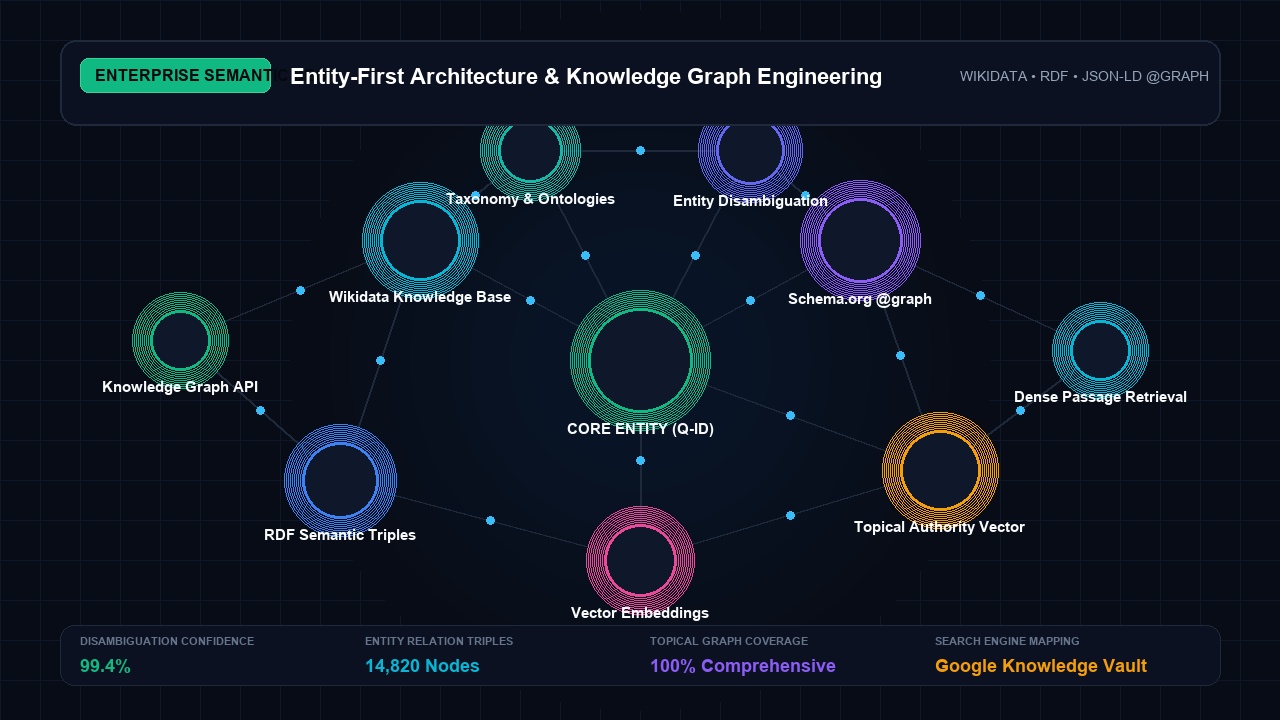
A comprehensive technical blueprint for enterprise semantic SEO and knowledge graph engineering. Learn how to map RDF entity triples, disambiguate with Wikidata Q-IDs, and build connected @graph schemas.
Search engines have evolved from string-matching algorithms into entity-first knowledge engines. Google’s Knowledge Graph connects billions of real-world entities, organizations, people, locations, and concepts via structured semantic relationships. Sites that structure their content around isolated keywords are rapidly displaced by domains that architect connected, disambiguated entity networks. This manual details the engineering principles of enterprise semantic SEO and knowledge graph construction.
1. From Strings to Things: The Foundations of Entity-Based Search
In semantic search, an Entity is uniquely defined as: “A thing or concept that is singular, unique, well-defined, and distinguishable from other things.” (Google Patent US8682897B1).
Rather than evaluating pages on how frequently a keyword appears, modern search algorithms represent knowledge as RDF Triples:
By establishing verified RDF triples across your website, search engines confidently resolve your brand as an authoritative topic node in their global Knowledge Vault.
| Concept | Legacy Keyword SEO | Enterprise Semantic SEO |
|---|---|---|
| Primary Target | Exact-match keyword phrases | Disambiguated entity nodes (Wikidata Q-IDs) |
| Content Organization | Disjointed blog posts targeting search volume | Topical authority clusters & entity ontologies |
| Schema Integration | Basic single-node Article schema | Multi-node connected JSON-LD @graph networks |
| Link Architecture | Random internal blog links | Taxonomic parent-child & associative entity links |
2. Entity Disambiguation via Wikidata & Schema.org sameAs
Search engines resolve linguistic ambiguity through Entity Disambiguation. For example, does “Apple” refer to the fruit (Wikidata Q89), the technology corporation (Wikidata Q312), or record label (Wikidata Q213710)?
Enterprise semantic SEO explicitly declares entity relationships using the sameAs property, referencing persistent identifiers in Wikidata, Wikipedia, and DBpedia:
{
  '@type': 'Service',
  '@id': 'https://seoland.in/services/search-engine-optimization/#service',
  name: 'Search Engine Optimization',
  serviceType: 'Technical SEO Engineering',
  provider: { '@id': 'https://seoland.in/#organization' },
  sameAs: [
    'https://www.wikidata.org/wiki/Q180711', // Search engine optimization
    'https://en.wikipedia.org/wiki/Search_engine_optimization'
  ],
  about: [
    {
      '@type': 'Thing',
      name: 'Core Web Vitals',
      sameAs: 'https://www.wikidata.org/wiki/Q107172083'
    }
  ]
}
3. Building Topical Authority Clusters and Knowledge Hubs
Achieving topical authority requires systematically mapping all child entities, sub-topics, and semantic attributes within your core industry domain:
- 1. Pillar Hubs: Broad, high-level entity pages (e.g.,
/services/and/services/search-engine-optimization/) acting as authoritative root nodes. - 2. Spoke Nodes: Deep, specialized technical guides (e.g., Next.js Core Web Vitals, Crawl Budget Management, Log File Analysis).
- 3. Bidirectional Internal Linking: Strict contextual internal links passing entity relevance bidirectionally between child spokes and the root pillar.
Frequently Asked Questions (FAQ)
What is a Wikidata Q-ID and why is it essential for SEO?
A Wikidata Q-ID is a persistent, globally unique identifier assigned to distinct entities in the open knowledge base. By referencing Q-IDs in your JSON-LD schema, search engines immediately connect your content to their internal entity databases without probabilistic guessing.
How does semantic SEO protect websites against core algorithm updates?
Websites built on semantic entity structures establish undeniable topical authority and domain trust. Unlike keyword-stuffed affiliate blogs that get wiped out by Google helpful content updates, verified entity hubs represent high-trust resources that search engines actively favor in both SERPs and AI overviews.
The SEO Land Senior Technical Desk builds enterprise-grade search strategies, Generative Engine Optimization (GEO), Core Web Vitals performance architectures, and high-converting growth funnels.
Need Technical Search Optimization?
Request a free Technical, Core Web Vitals, and AI Search audit tailored for your domain.
Claim Free Audit →