The Definitive Guide to Next.js 15+ Technical SEO & Core Web Vitals
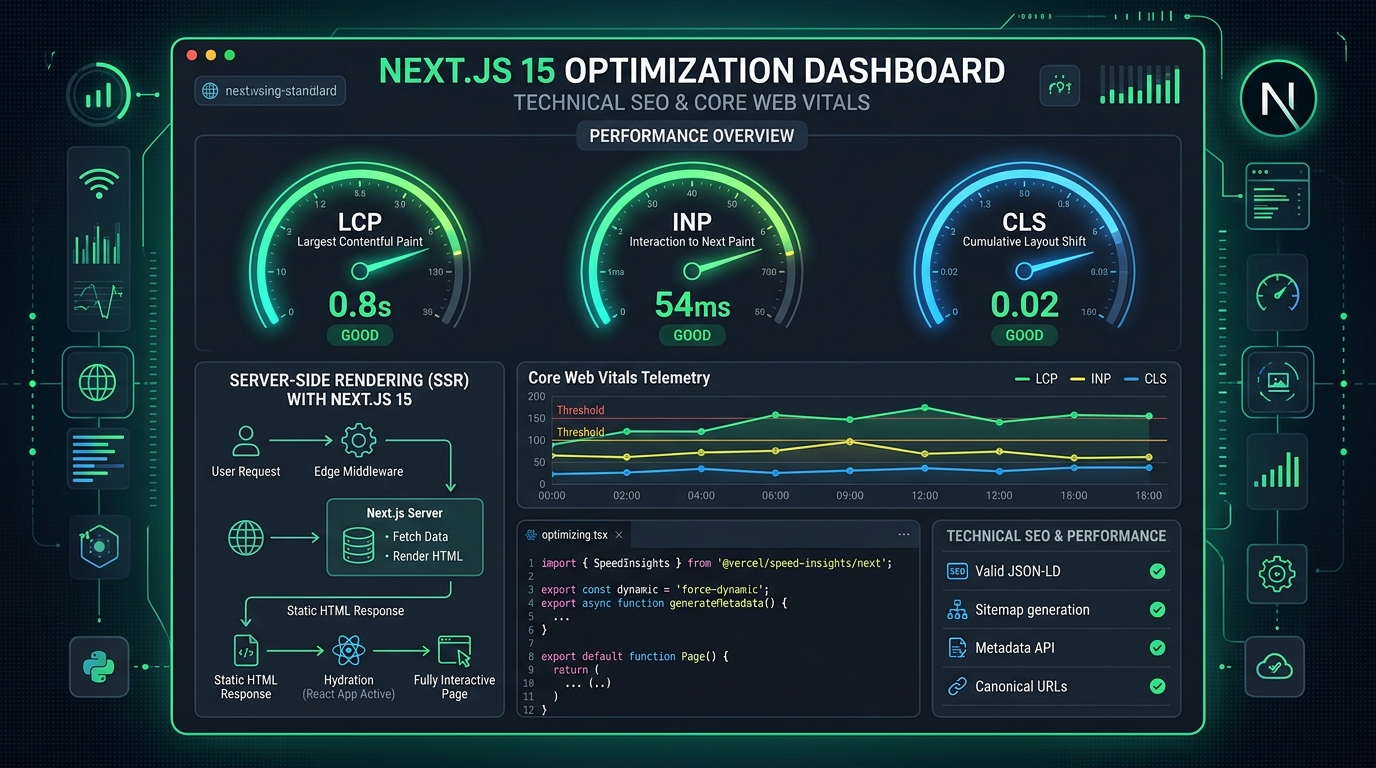
An authoritative engineering manual for Next.js 15 technical SEO. Master Server Components, dynamic ISR, streaming SSR, metadata API, JSON-LD @graph schemas, and sub-second Core Web Vitals optimization.
- 01.1. The Next.js 15 Rendering Continuum: Server Components vs ISR vs SSR
- 02.2. Production Next.js 15 Metadata API & Dynamic OpenGraph Architecture
- 03.3. Core Web Vitals Dominance: INP, LCP, and CLS Optimization
- 04.Interaction to Next Paint (INP < 200ms)
- 05.Largest Contentful Paint (LCP < 2.5s)
- 06.Cumulative Layout Shift (CLS < 0.1)
- 07.4. JSON-LD Schema Graph Architecture in Next.js 15
- 08.Frequently Asked Questions (FAQ)
As the web transitions from traditional single-page client rendering to hybrid server-driven architectures, Next.js 15 has emerged as the premier framework for search-engine-optimized applications. However, misconfigured edge middleware, uncontrolled hydration waterfalls, unoptimized dynamic image assets, and flawed metadata hierarchies routinely cripple organic search visibility. This guide provides an exhaustive engineering breakdown for architecting enterprise-scale Next.js 15 applications optimized for Googlebot indexing and Core Web Vitals dominance.
1. The Next.js 15 Rendering Continuum: Server Components vs ISR vs SSR
Search engines require deterministic, pre-rendered semantic HTML. Relying on client-side JavaScript execution forces Googlebot into the two-stage indexing pipeline (crawl → render queue → indexation), introducing crawl delays of days or weeks.
Next.js 15 App Router resolves this by enforcing React Server Components (RSC) by default. Zero component JavaScript is shipped to the browser for static leaves, eliminating hydration overhead entirely.
| Rendering Strategy | Use Case | TTFB (Time to First Byte) | Crawl Budget Efficiency | Googlebot Indexation Speed |
|---|---|---|---|---|
| Static Site Generation (SSG) | Evergreen marketing & documentation | < 50ms (Edge CDN) | 100% Maximum | Instant (Phase 1) |
| Incremental Static Regeneration (ISR) | High-volume e-commerce & publishing | < 80ms (Stale-While-Revalidate) | 98% Superior | Instant (Cached) |
| Server-Side Rendering (SSR) | Personalized user accounts & real-time pricing | 200ms – 450ms (Origin compute) | Moderate (Compute-bound) | Instant (Pre-rendered) |
| Client-Side Rendering (CSR) | Private dashboards & interactive tools | > 800ms (Hydration bound) | Low (Heavy render queue) | Delayed (Phase 2 WRS) |
2. Production Next.js 15 Metadata API & Dynamic OpenGraph Architecture
Modern search engines and social platforms evaluate OpenGraph, canonical URLs, alternates, and robots directives. The Next.js 15 generateMetadata async function allows asynchronous resolution of dynamic slugs with automated deduplication:
import type { Metadata, ResolvingMetadata } from 'next';

type Props = {
  params: Promise<{ slug: string }>;
};

export async function generateMetadata(
  { params }: Props,
  parent: ResolvingMetadata
): Promise<Metadata> {
  const { slug } = await params;
  const post = await fetchPostBySlug(slug);

  if (!post) {
    return { title: 'Page Not Found — SEO Land', robots: { index: false } };
  }

  const canonicalUrl = ;

  return {
    title: ,
    description: post.excerpt,
    alternates: { canonical: canonicalUrl },
    openGraph: {
      title: post.title,
      description: post.excerpt,
      url: canonicalUrl,
      siteName: 'SEO Land',
      images: [{ url: post.featuredImage, width: 1200, height: 630 }],
      type: 'article',
      publishedTime: post.publishedAt,
    },
    robots: {
      index: true,
      follow: true,
      'max-snippet': -1,
      'max-image-preview': 'large',
    },
  };
}
3. Core Web Vitals Dominance: INP, LCP, and CLS Optimization
Passing Google’s Core Web Vitals thresholds (75th percentile of actual real-user Chrome telemetry) directly boosts search rankings under Google’s Page Experience signal.
Interaction to Next Paint (INP < 200ms)
INP replaced FID as an official Core Web Vital in March 2024. In React applications, long JavaScript execution during event handlers (clicks, keypresses) blocks the main thread. To achieve an elite INP (< 80ms):
- Decouple State Transitions: Wrap heavy non-urgent UI updates in
React.useTransition()to yield main thread priority to user input. - Eliminate Global Hydration: Use client boundary islands (
'use client') strictly at interactive component leaves rather than wrapping entire page layouts. - Debounce Form Inputs: Never trigger client-side re-renders on every keystroke without 150ms debounce intervals.
Largest Contentful Paint (LCP < 2.5s)
The LCP element in 90% of blog and landing pages is the hero featured image. Next.js next/image provides critical optimizations:
- Use the
priorityattribute on above-the-fold hero images to emit a high-priority<link rel="preload">in the initial HTML head. - Always define explicit
sizes="(max-width: 768px) 100vw, (max-width: 1200px) 50vw, 33vw"to avoid serving desktop-resolution payloads to mobile viewports. - Configure modern image formats (
formats: ['image/avif', 'image/webp']) innext.config.tsfor up to 50% byte savings over standard JPEG.
Cumulative Layout Shift (CLS < 0.1)
Unexpected layout shifts during page loading degrade user experience and trigger Core Web Vitals penalties:
- Always declare explicit
aspect-ratioorwidthandheightattributes on image containers and ad frames. - Pre-reserve layout space for dynamic ad banners using min-height skeleton placeholders to prevent ad injection shifts.
- Use
next/font/googleto automate local font self-hosting and eliminate flash of unstyled text (FOUT) layout shifts.
4. JSON-LD Schema Graph Architecture in Next.js 15
Search engines consume structured entity graphs rather than isolated schema snippets. Linking your Organization, WebSite, Author, and Article nodes within a single unified @graph enables rich SERP snippet qualification:
const schemaGraph = {
  '@context': 'https://schema.org',
  '@graph': [
    {
      '@type': 'Organization',
      '@id': 'https://seoland.in/#organization',
      name: 'SEO Land',
      url: 'https://seoland.in/',
      logo: {
        '@type': 'ImageObject',
        url: 'https://seoland.in/assets/images/logo.png',
      },
    },
    {
      '@type': 'WebSite',
      '@id': 'https://seoland.in/#website',
      url: 'https://seoland.in/',
      name: 'SEO Land',
      publisher: { '@id': 'https://seoland.in/#organization' },
    },
    {
      '@type': 'BlogPosting',
      '@id': ,
      isPartOf: { '@id': 'https://seoland.in/#website' },
      headline: post.title,
      description: post.excerpt,
      mainEntityOfPage: postUrl,
      author: {
        '@type': 'Organization',
        name: 'SEO Land Editorial Team',
        url: 'https://seoland.in/blog/author/seoland-editorial-team/',
      },
      publisher: { '@id': 'https://seoland.in/#organization' },
    },
  ],
};
Frequently Asked Questions (FAQ)
Why is Next.js App Router superior to Pages Router for SEO?
The App Router introduces React Server Components by default, which executes component logic entirely on the server and strips all unnecessary React framework runtime code from the client bundle. This results in significantly faster First Contentful Paint (FCP) and near-zero hydration waterfalls for web crawlers.
How do Next.js route handlers impact crawl budget?
Route handlers configured with ISR or edge caching respond in sub-50ms intervals. Because Googlebot allocates crawl budget based on origin server latency and error rates, fast, cached responses enable search crawlers to index substantially more URLs per crawl cycle without server strain.
What is the recommended revalidation interval for high-velocity blogs?
For frequently updated content hubs, a revalidation window of 3,600 seconds (1 hour) provides the ideal balance between fresh content delivery and edge cache hit ratios, ensuring that 99%+ of user and bot requests are served directly from edge CDN cache.
The SEO Land Senior Technical Desk builds enterprise-grade search strategies, Generative Engine Optimization (GEO), Core Web Vitals performance architectures, and high-converting growth funnels.
Need Technical Search Optimization?
Request a free Technical, Core Web Vitals, and AI Search audit tailored for your domain.
Claim Free Audit →