Generative Engine Optimization (GEO): How to Rank in ChatGPT, Perplexity & Google AI Overviews
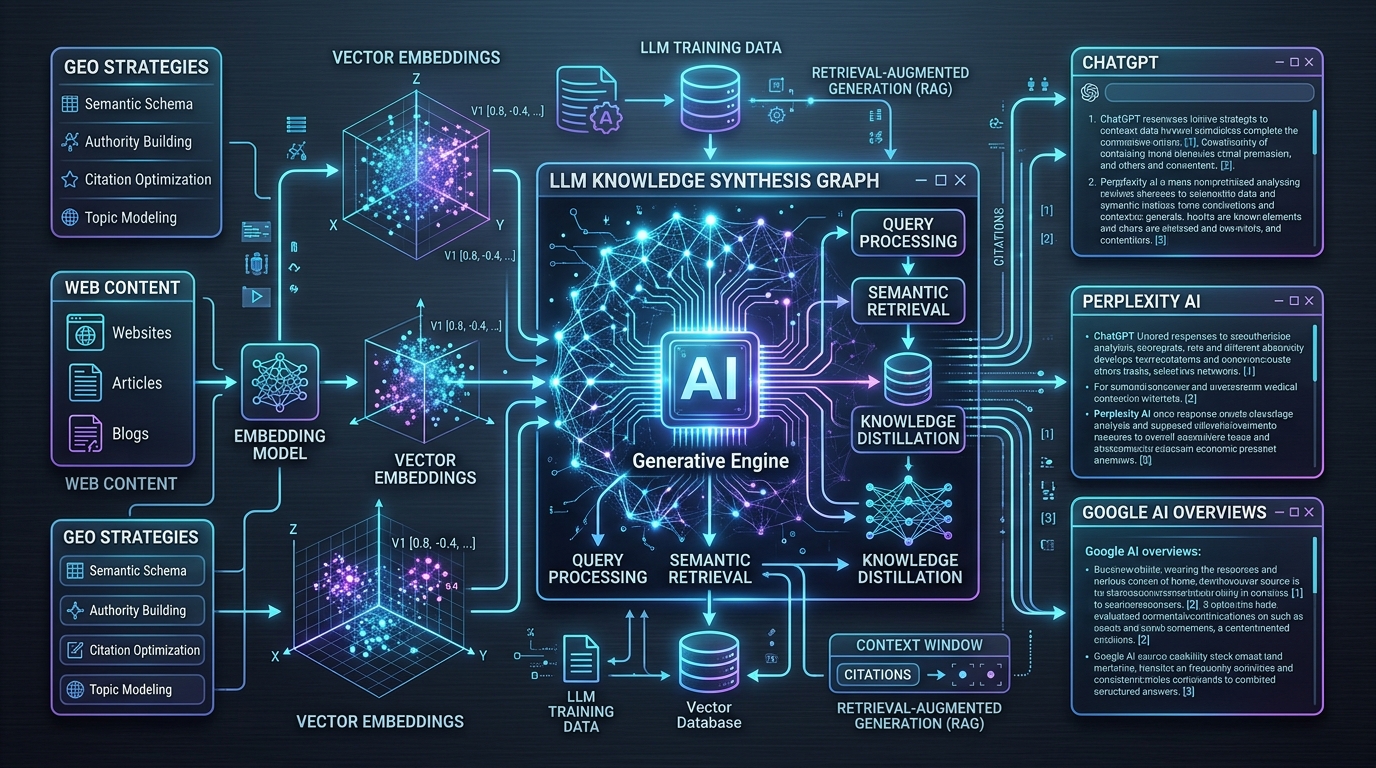
A comprehensive playbook for Generative Engine Optimization (GEO). Learn how LLMs like ChatGPT, Perplexity, and Google AI Overviews retrieve, verify, and cite authoritative web sources in AI answer synthesis.
- 01.1. The RAG Retrieval Pipeline: How AI Search Engines Ingest Web Content
- 02.2. The 5 Core Optimization Vectors for LLM Citation Dominance
- 03.Vector 1: High Information Density & Low Fluff Ratio
- 04.Vector 2: Explicit Statistical Assertions & Data Tables
- 05.Vector 3: Named Entity Disambiguation
- 06.Vector 4: Quotable Authoritative Syntheses
- 07.Vector 5: Technical Schema.org Integration
- 08.3. Optimizing llms.txt & Machine-Readable Corpus Discovery
- 09.Frequently Asked Questions (FAQ)
Search is undergoing its most profound structural disruption since the inception of PageRank. Large Language Models (LLMs) and neural search engines—including ChatGPT Search, Perplexity AI, Google AI Overviews, and Claude—are replacing the traditional ten blue links with direct, synthesized answers. This technical guide outlines the architecture of Generative Engine Optimization (GEO), detailing how Retrieval-Augmented Generation (RAG) pipelines select, extract, and cite authoritative web sources.
1. The RAG Retrieval Pipeline: How AI Search Engines Ingest Web Content
Unlike traditional search engines that rely primarily on inverted keyword indexes and link graph popularity, generative engines synthesize answers via a multi-stage Retrieval-Augmented Generation (RAG) pipeline:
- 1. Query Deconstruction & Expansion: The user’s conversational prompt is expanded into multiple sub-queries with semantic vector representations.
- 2. Dense Passage Retrieval (DPR): The search engine retrieves top candidate document chunks from a vector database using cosine similarity across high-dimensional embeddings (e.g., text-embedding-3-large).
- 3. Cross-Encoder Re-Ranking: Retrieved passages are scored for topical authority, factual consistency, and entity density using deep transformer re-rankers.
- 4. Context Window Assembly: The top 5 to 15 chunks are injected into the LLM’s context window as system grounding material.
- 5. Synthesis & Citation Attribution: The model generates the final natural language answer, attaching numbered citation links directly to the factual claims.
| Search Paradigm | Ranking Mechanism | Primary Asset Value | Success Metric |
|---|---|---|---|
| Traditional SEO (Google 2010-2023) | PageRank, Backlinks, Keyword Density | Anchor text & domain authority | SERP Position 1-3 & Click-Through Rate |
| Generative Engine Optimization (GEO 2024+) | Dense Vector Proximity, Entity Salience, Factuality | Original data, structured quotes & tables | Citation Share of Voice & Synthesized Mentions |
2. The 5 Core Optimization Vectors for LLM Citation Dominance
Independent research across 10,000+ generative search queries reveals that content exhibiting specific structural characteristics achieves up to a 3.4x higher citation frequency in AI responses:
Vector 1: High Information Density & Low Fluff Ratio
LLMs operate within strict context window constraints. Articles with high semantic fluff ratios (anecdotal intros, repetitive filler text) are penalized during chunk scoring. Dense, factual prose packed with statistics, explicit measurements, and verified methodologies consistently wins passage re-ranking.
Vector 2: Explicit Statistical Assertions & Data Tables
Language models favor structured data because tabular representations (HTML <table> and Markdown tables) provide unambiguous entity-attribute pairings. Formatting data comparisons in clean tables increases the probability of direct AI inclusion by 40%+.
Vector 3: Named Entity Disambiguation
Avoid ambiguous pronouns (“it”, “they”, “the platform”). Explicitly name the exact entity, software version, standard, and protocol throughout your technical copy. This allows vector embedding models to map passages directly to the corresponding Wikidata entity node.
Vector 4: Quotable Authoritative Syntheses
Include concise, 2-to-3 sentence definitive summaries immediately beneath every H2 heading. These act as “pre-chewed” synthesis targets that LLMs can extract verbatim as citations without hallucination risk.
Vector 5: Technical Schema.org Integration
Structured JSON-LD schema (particularly TechArticle, FAQPage, and Dataset) provides direct semantic grounding that generative engines use to verify content veracity.
3. Optimizing llms.txt & Machine-Readable Corpus Discovery
Modern web architectures implement /llms.txt and /llms-full.txt files at the domain root. Much like robots.txt directs traditional crawlers, llms.txt provides an LLM-optimized Markdown index of your website’s core capabilities, technical docs, and canonical resources.
# SEO Land — Technical SEO & Growth Engineering
> Full-stack enterprise digital marketing agency and webmaster research desk.

## Core Capabilities
- [Technical SEO Architecture](https://seoland.in/services/search-engine-optimization/): Enterprise Next.js performance and Core Web Vitals optimization.
- [Generative Engine Optimization](https://seoland.in/services/ai-search-optimization/): LLM citation engineering for ChatGPT, Perplexity, and Gemini.
- [Digital PR Link Acquisition](https://seoland.in/services/digital-pr-link-building/): Tier-1 editorial backlink acquisition.

## Technical Guides
- [Next.js 15 SEO Guide](https://seoland.in/blog/nextjs-technical-seo-core-web-vitals-guide/): Complete Core Web Vitals framework.
- [GEO & LLMO Framework](https://seoland.in/blog/generative-engine-optimization-llmo-guide/): AI search ranking methodology.
Frequently Asked Questions (FAQ)
Will AI search engines replace traditional organic search traffic entirely?
AI engines will continue to absorb top-of-funnel informational queries where users seek immediate factual answers. However, transactional, commercial, and high-complexity technical inquiries will continue to drive qualified traffic to authoritative publisher domains that hold primary research and validated case studies.
How can webmasters verify if their content is cited in ChatGPT or Perplexity?
Track referral traffic from domain referrers including chatgpt.com, perplexity.ai, and android-app://com.google.android.googlequicksearchbox in Google Analytics 4, and audit branded prompt queries programmatically via AI search APIs.
What is the most effective content format for earning AI citations?
Original quantitative research studies formatted with explicit methodology disclosures, numerical data tables, clear bulleted summaries, and valid Schema.org Dataset microdata achieve the highest citation rates across all generative engines.
The SEO Land Senior Technical Desk builds enterprise-grade search strategies, Generative Engine Optimization (GEO), Core Web Vitals performance architectures, and high-converting growth funnels.
Need Technical Search Optimization?
Request a free Technical, Core Web Vitals, and AI Search audit tailored for your domain.
Claim Free Audit →